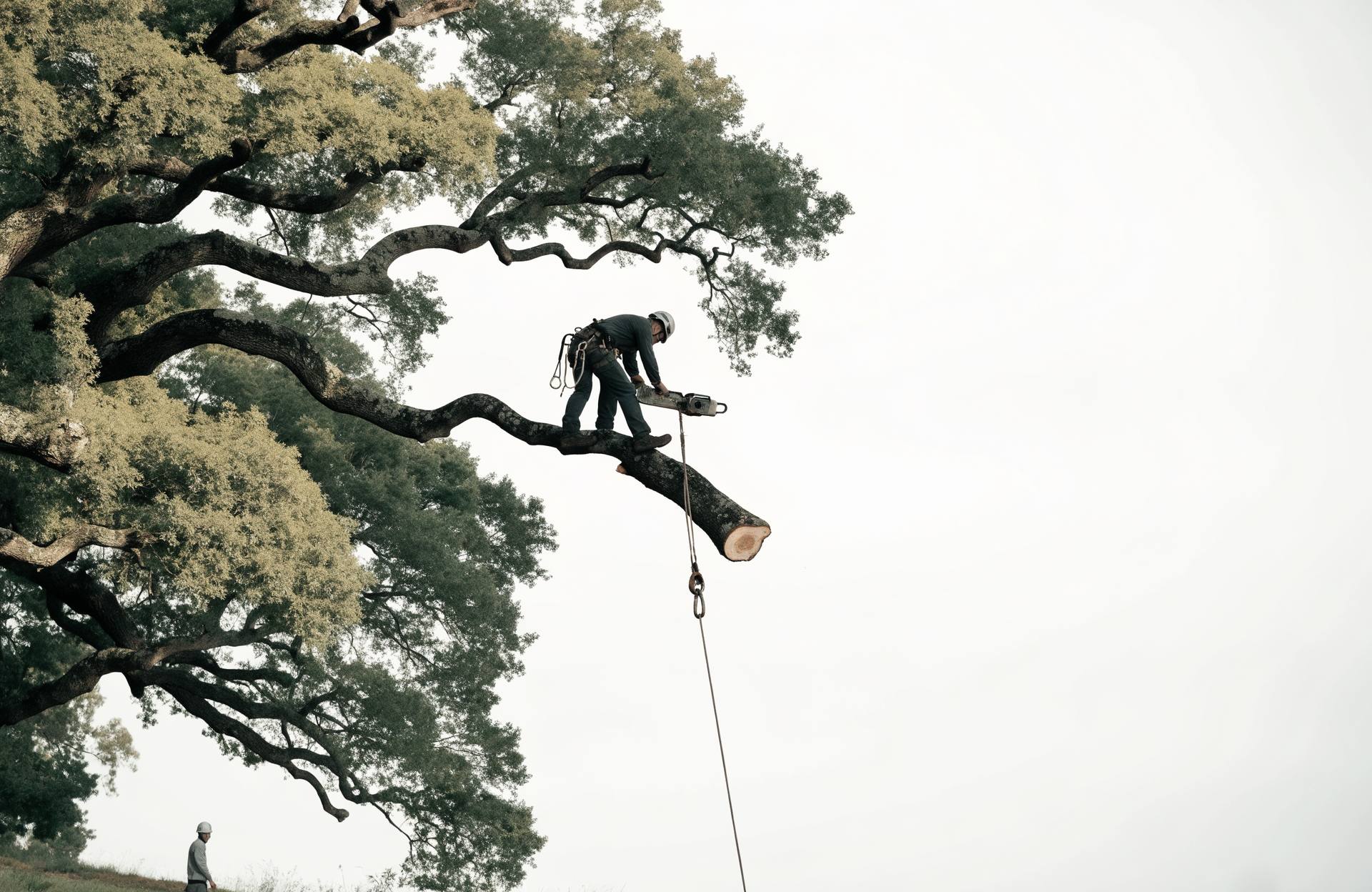
Tree Removal Cost in Pooler, GA: What Actually Drives the Price
Five things move the number, and four of them cannot be judged from a phone call.
The short version
- Access matters more than size on most residential jobs.
- Any firm price given without seeing the tree is a guess.
- Stump grinding is a separate line, and cheapest on the same visit.
- The estimate itself should cost you nothing.
Homeowners in Pooler regularly get three quotes for the same tree that are nowhere near each other, and it is genuinely confusing. The spread is usually not one company being greedy. It is that the three crews are planning to do the job three different ways, and the method is most of the price.
1. Access, which is the big one
If a bucket truck and a chipper can back up close to the tree, the work is efficient. Cut, drop, feed the chipper, move on. If everything has to be carried by hand through a three foot gate to a back garden, the same tree can take twice as long with the same crew.
This is why quotes in the newer neighbourhoods off Pooler Parkway often come in higher than people expect. The houses sit close together, the lots are tight, and there is frequently no side access wide enough for equipment. It is also why a tree on an open acre in Bloomingdale can be surprisingly cheap. There is room to fell it in one piece.
2. What sits underneath it
An open lawn is the cheapest thing that can be under a tree. A roof, a fence, a pool, a septic field, an irrigation system, or a neighbour's screened porch all mean that nothing can simply be dropped. Every piece gets tied off, cut, and lowered under control. That is slower, it needs more rigging, and it carries more risk, so it costs more.
3. Size, measured properly
People describe trees by height, but the wood volume that has to be cut, moved, and hauled tracks diameter far more than height. Doubling the trunk diameter roughly quadruples the volume. A 60 foot pine with a slim trunk is a much smaller job than a 60 foot live oak with a heavy spreading crown, even though a homeowner would describe both as sixty feet.
4. Species and condition
Live oak is dense and heavy, and its limbs run out laterally rather than up, so a single limb can weigh more than a whole small tree. Pine is lighter but tall, with little taper. A dead or decayed tree is a different proposition again, because a climber cannot trust the wood, and that changes the whole approach. Read more on the signs a tree is failing.
5. The extras
- Stump grinding. Quoted separately so you can decide, and much cheaper while the machine is already in your yard than as a return trip. See stump grinding.
- Hauling the grindings. Real volume and real weight, so it is priced on its own.
- Permit work where Pooler or Chatham County requires it.
- Crane time on the occasional job where a pick from the street is genuinely cheaper than two days of rigging.
Why we will not quote a number over the phone
Four of the five factors above cannot be assessed from a description. We have turned up to trees that sounded straightforward and found a hollow trunk, and to trees that sounded frightening and were an hour's work. A phone number given sight unseen is either padded to cover the unknown, which costs you, or optimistic and revised upward on the day, which is worse.
So we come and look, the visit is free, and the price goes in writing before anything starts. If we find something on the day that genuinely changes the work, most often internal decay that only shows once the first cut opens the trunk, we stop and talk to you rather than presenting a bigger invoice at the end.
Getting comparable quotes
If you are collecting several estimates, make them comparable:
- Ask whether debris removal is included or extra.
- Ask whether the stump is included, and to what depth.
- Ask for the certificate of insurance, and check the name on it matches.
- Ask what happens if they find decay once they start.
- Get it in writing. All of it.
A quote that is dramatically below the others usually differs in one of those five points rather than being a better deal. The most common gap is haul-off, where the crew cuts everything up, stacks it at the kerb, and leaves.
When you are ready, we quote tree removal in Pooler on site and in writing, and the estimate is free.
Get a Free Estimate in Pooler
Send a photo of the tree and what is around it. Licensed, insured, and the debris leaves with us.
Call or text anytime. If we miss you, we’ll call you right back.