Tree removal
When the structure is compromised or the tree has simply outgrown the lot, pruning is not the answer.
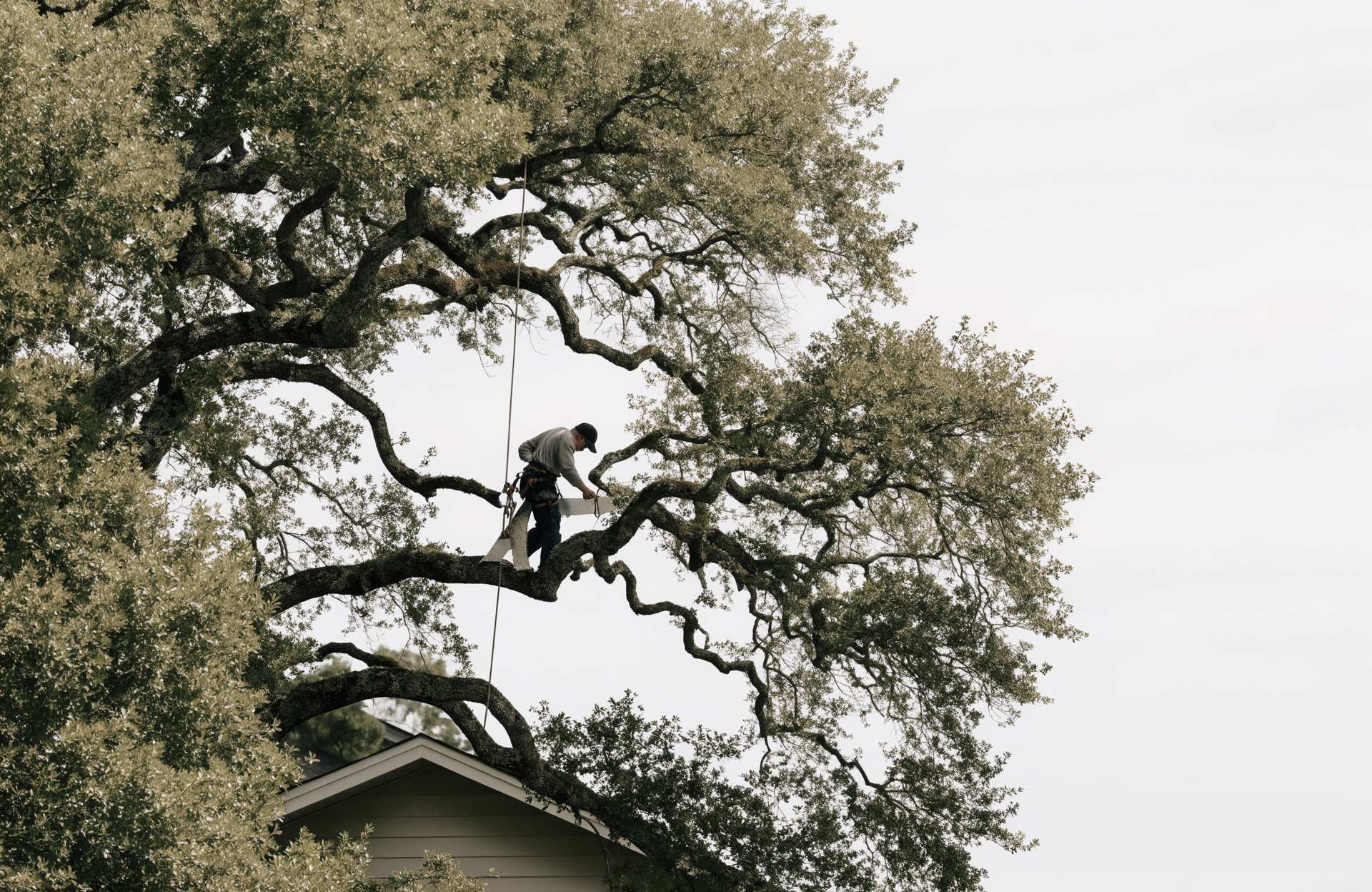
Limbs cleared off rooflines and driveways, deadwood taken out, and canopies thinned before hurricane season. Pruned to standard, with proper cuts. We do not top trees.
Call or text anytime. If we miss you, we’ll call you right back.
Tell us what the tree is doing. Over the roof, into the drive, dropping limbs.
Trimming is often the alternative to tree removal in Pooler, and we would rather sell you the cheaper job when the tree can be kept. Most of what we do here is clearance work, getting limbs off a roof, out of a driveway, or away from a service line, plus taking deadwood out of mature oaks and thinning canopies before storm season.
"Trimming" covers several different jobs, and knowing which one you need keeps you from paying for the wrong thing:
One thing worth knowing about lines. The utility maintains clearance around the primary distribution lines running along the street, and that work is theirs rather than something you pay for. The service drop from the pole to your house is a different matter and is generally the homeowner's responsibility. If limbs are sitting on that drop, say so when you call, because it changes how we approach the job and sometimes means coordinating with the utility before we start.
Topping means cutting limbs back to stubs with no regard for where the growth points are. It is the fastest way to make a tree smaller and it is genuinely damaging. The stubs cannot seal properly, so decay moves down into the trunk, and the tree responds by throwing dozens of fast, weakly attached shoots that are more likely to fail in wind than what you removed. You end up with a taller, denser, weaker tree in about five years, plus a standing decay problem. Anyone offering to top your oak cheaply is selling you a removal on a delay. Proper reduction cuts cost more and are the only version we do.
Coastal Georgia takes tropical systems from June through November, and a well-thinned canopy genuinely does move less in high wind. The catch is that this is the easiest thing in the trade to get wrong. Stripping the interior foliage and leaving tufts of green at the ends of long bare limbs, sometimes called lion-tailing, looks tidy and makes the tree measurably more likely to break. All the weight ends up at the far end of the lever, and the interior growth that was helping the limb taper is gone.
Correct thinning is selective and modest. It removes crossing, rubbing, and dead material, opens the canopy evenly through its depth, and takes weight off the ends of the longest limbs rather than off the middle of the tree. As a general rule we do not take more than about a quarter of the live canopy off a healthy mature tree in a season, and less than that from one that is old, stressed, or recently damaged.
Late winter, while hardwoods are dormant, is the best window for most structural pruning. The leaves are off so the framework is visible, cuts seal quickly once spring growth starts, and there is less material to chip. Dead limbs can come out any time of year, and so can anything that is a hazard, which never waits for a season. We avoid heavy pruning during the spring flush and during drought stress, when the tree has the least reserve to respond with.
Two local notes. Crape myrtles are pruned in late winter before growth starts, and they do not need the annual amputation they get all over the South. Cabbage palms want only the genuinely dead fronds taken, not the severe hurricane cut, which strips the tree of its own food supply right before it needs it most.
Trimming reduces risk. It does not eliminate it, and no honest crew will tell you otherwise. If a storm does come through and leaves limbs down or hung up in the canopy, that is storm damage cleanup, and a tree already on a structure is emergency tree removal.
When the structure is compromised or the tree has simply outgrown the lot, pruning is not the answer.
A tree already on the house or across the drive. Storm work takes priority over scheduled jobs.
Torn limbs and debris after a system passes, plus a look at what is left hung up in the canopy.
If the tree does come out, grinding the stump on the same visit is the cheapest time to handle it.
Proper trimming makes cuts at a branch union, so the tree can seal the wound and the remaining limb keeps a natural shape. Topping cuts limbs back to stubs wherever is convenient. Those stubs do not seal, decay moves down into the trunk, and the tree responds with a mass of fast, weakly attached shoots that break more easily than what was removed. Topping is cheaper on the day and expensive over a decade.
Late winter, while hardwoods are dormant, is the best window for structural pruning. The framework is visible with the leaves off, cuts seal quickly once spring growth begins, and there is less material to chip. Deadwood and anything hazardous can be handled any time of year. We avoid heavy pruning during the spring flush and during drought stress, when the tree has the least reserve to recover with.
It reduces the risk and it does not eliminate it. Thinning lets wind pass through the canopy instead of pushing it, and taking weight off long limbs reduces leverage on the attachment points. But a tree with internal decay, a split union, or a lifting root plate is a removal candidate, and no amount of pruning changes that. We will tell you which one you have.
As a general rule, no more than about a quarter of the live canopy from a healthy mature tree in a single season, and less from one that is old, stressed, or recently damaged. Leaves are how the tree feeds itself, so removing too much at once weakens exactly the tree you are trying to protect. If a tree needs a lot of work, spreading it across two seasons is better than doing it all at once.
Yes. Crape myrtles get topped to knuckles every winter all over the South and they do not need it. They bloom on new growth, so the flowering argument for cutting them back hard does not hold up. We take out crossing and interior growth, remove suckers at the base, and thin for shape in late winter before growth starts. The tree keeps its bark and its form, which is most of why you planted it.
Send a photo of the whole tree and tell us what it is doing. Licensed, insured, and the brush leaves with us.
Call or text anytime. If we miss you, we’ll call you right back.