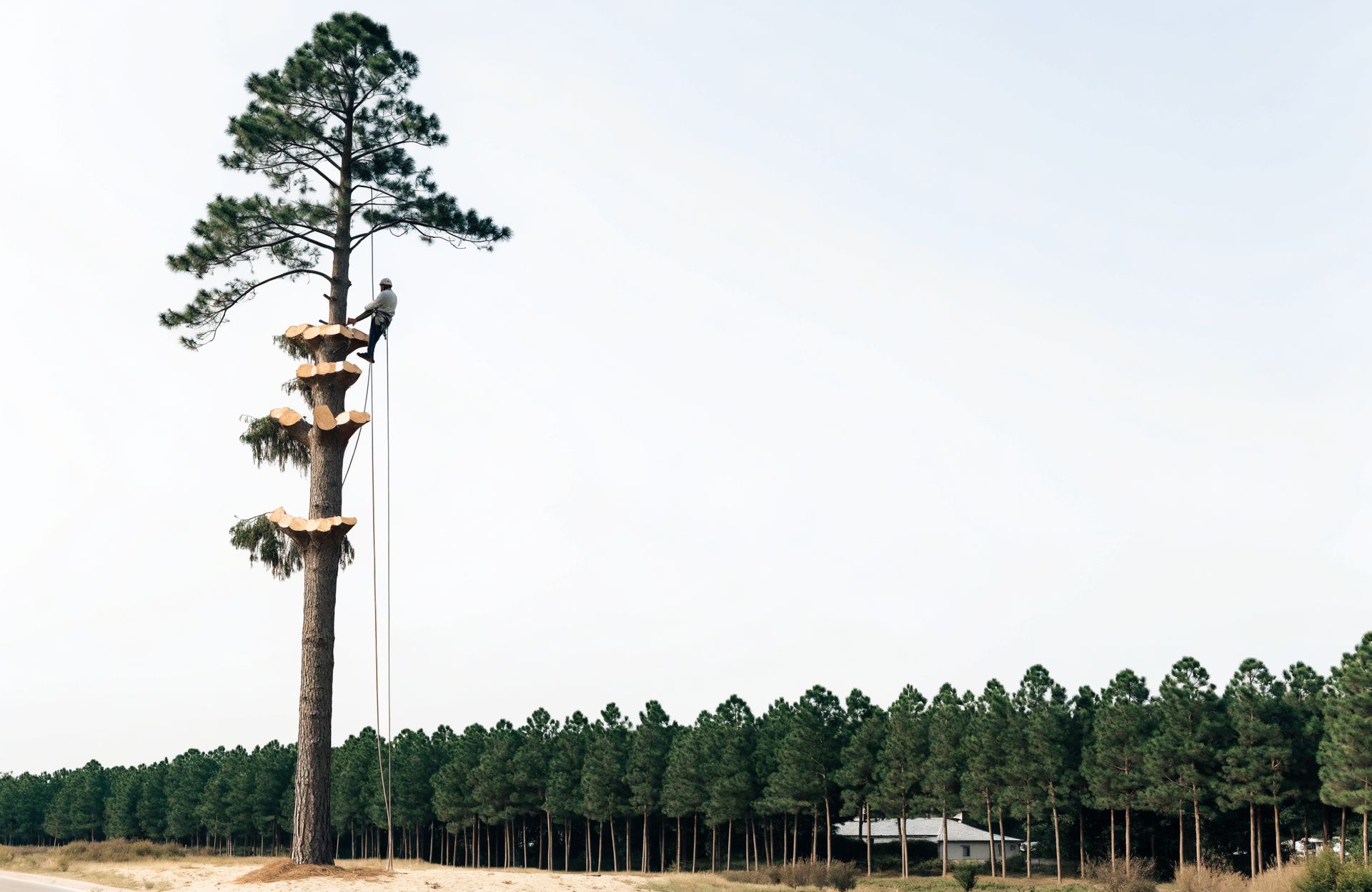
Why Saturated Soil Puts Chatham County Pines on the Ground
It is rarely the wind alone. It is the wind plus a week of rain.
The short version
- Our pines are shallow rooted relative to their height.
- Saturated ground gives those roots far less to grip.
- A pine that grew inside a stand never had to stand alone in wind.
- Cracked or heaving soil at the base is the warning sign.
After a storm moves through Chatham County the pattern is consistent. Some pines snap partway up, but a great many simply tip over with the root plate lifting out of the ground like a trapdoor, taking a disc of lawn with it. The wind gets the blame. The ground deserves most of it.
Shallow plates, tall trees
Loblolly and slash pine, the two species that dominate residential lots from Pooler out to Rincon, do not put down a deep taproot in mature form. They develop a wide, relatively shallow root plate. On a 90 foot tree that is a long lever standing on a fairly flat base, and it works fine as long as the base has something firm to hold.
The coastal plain is flat, sandy in places and heavy in others, and it holds water. Our water table sits high. After a stretch of heavy rain, the soil that root plate depends on turns to something closer to a slurry. The roots are still there and still intact. What has changed is that the material around them no longer grips.
Why the timing catches people out
This is why pines here so often come down late in a storm or in the day or two afterwards, sometimes in wind that seems unremarkable compared to what already blew through. The rain arrives first and saturates the ground, then the wind works on a tree whose footing has quietly changed. A gust that the tree would have shrugged off in dry August ground is a different proposition in waterlogged October ground.
It also explains why a tree that has stood through decades of storms can go in a season that was not the worst one it has seen. It is not that the tree got weaker in a straightforward sense. The conditions under it were different.
The subdivision problem
There is a second factor specific to how this area was developed. A great deal of residential land around Pooler, Port Wentworth, and Rincon was pine stand or managed timber before it was lots. When a builder clears a stand and leaves a handful of pines standing as amenity, those survivors have a particular history.
A pine that grew up inside a dense stand competed for light, so it put its energy into height rather than girth. It has a tall, slim trunk with very little taper and a small canopy right at the top. Crucially, it never had to stand alone in wind, because the trees around it sheltered it and it sheltered them. Remove the stand and that tree is suddenly exposed on every side with a root system and a trunk that developed under completely different conditions.
Some adapt over several seasons, thickening up and rooting out. Plenty do not. And because they were all the same age and height, when one goes the ones beside it are frequently next.
What to look for
- Fresh soil heaving or a crescent shaped crack in the turf on the side opposite the lean. This is the plate beginning to lift and it is the clearest warning you will get.
- A lean that is new, or one that has changed after a wet spell.
- An isolated tall pine within falling distance of the house, especially in a neighbourhood cleared in the last twenty years.
- Clusters of same-age pines where one has already failed.
What you can actually do
Once a root plate has started to move, the tree is a removal rather than something to monitor. Soil does not re-grip. For pines that are still sound but exposed, sensible canopy work before hurricane season reduces the sail area the wind can push against, though it cannot change what is happening underground. And if a system has already been through, it is worth having the trees left standing looked at, because the aftermath is when the next failure is set up.
Hurricane season here runs June through November. The cheapest time to deal with a questionable pine is a dry week in February.
Get a Free Estimate in Pooler
Send a photo of the tree and what is around it. Licensed, insured, and the debris leaves with us.
Call or text anytime. If we miss you, we’ll call you right back.